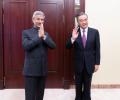
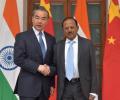
External affairs minister S Jaishankar has told his Chinese counterpart Wang Yi that the two sides should work for an early resolution of the remaining issues along the LAC in eastern Ladakh to restore peace and tranquility in the border areas as this has been an essential basis for progress in Sino-India ties.
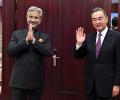
A five-point agreement was reached between Jaishankar and Wang at a meeting in Moscow on September 10 on the sidelines of a Shanghai Cooperation Organisation conclave.
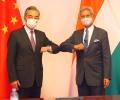
Jaishankar said full restoration and maintenance of peace and tranquillity in border areas was essential for the development of the bilateral ties.
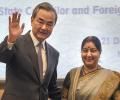
China has been trying to build lobbies of influence and mould public opinion in India since at least 2017, and large sums have been invested in the effort, reveals former RA&W officer Jayadeva Ranade.
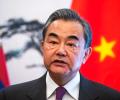
Was Wang Yi'S visit intended to remind India of 1962, asks Claude Arpi?

Pakistan's Foreign Minister Shah Mahmood Qureshi and his Chinese counterpart Wang Yi discussed ways to further strengthen the "iron-clad friendship" between the two countries as the two sides signed five agreements to deepen their bilateral cooperation in various fields, the foreign office said on Tuesday.

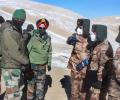
The armies are working to schedule their seventh round of talks to take steps towards "early and complete" disengagement of troops along the LAC in eastern Ladakh.
The two sides have already held 21 rounds of talks under the framework of SR dialogue which was set up to find an early solution to the border dispute.
During their hour-long in-person meeting on the sidelines of a Shanghai Cooperation Organisation (SCO) conclave in Dushanbe on Wednesday, External Affairs Minister S Jaishankar also told his Chinese counterpart and State Councilor Wang Yi that any unilateral change in the status quo along the Line of Actual Control (LAC) was 'not acceptable' to India and that the overall ties can only develop after full restoration of peace and tranquillity in eastern Ladakh.
'China and India have encountered some setbacks in recent years which do not serve the fundamental interests of the two countries and the two peoples'
The MEA said there has not been any change in India's position on the LAC and the mutual redeployment as a result of the disengagement process should not be misrepresented.
'We stress that the boundary issue shall not be linked with the overall bilateral relations. That is an important experience we have gathered through many years' effort to keep the ties moving forward
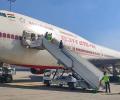
The flight arrived at Wuhan's Tianhe International Airport on Friday evening. While the official number of students to be airlifted in the two flights is not known, Indians who reached the Wuhan airport on Friday said they were told that 374 were expected to be airlifted by the Air India flight. India has taken an undertaking from the Indians travelling in the two flights that they would be quarantined for 14 days after their arrival, besides undergoing special checks at the Wuhan airport.
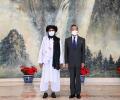
China may accord recognition to the new government in Kabul at an early opportunity, predicts Ambassador M K Bhadrakumar

A deft hand on India-China relations, Bambawale earlier handled the China desk at the MEA.
It is apparent that an easing of tensions at the border and a disengagement of troops is on the cards, observes Ambassador M K Bhadrakumar.
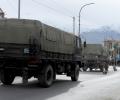
China is in no hurry to disengage at the border and the region and international community is moving on. The spectre of a long haul in Ladakh haunts India, points out Ambassador M K Bhadrakumar.

Continuing his fast-paced diplomacy, Indian Prime Minister Narendra Modi spoke to China's Premier Li Keqiang on Thursday. During the phone call, Li conveyed his government's desire to establish a robust partnership with the new government in India.

Modi was expected to arrive in Wuhan in the evening on April 26 and join Xi in the informal summit at a picturesque location the next day.
'It is advisable for Indian interlocutors to follow the Chinese tactic of repeating the Indian position, both for the record and to test the Chinese negotiator's resolve and intentions.' A riveting excerpt from former foreign secretary Vijay Gokhale's The Long Game: How the Chinese Negotiate With India.
The effort made to define the larger picture by focussing on history and the wish not turn differences into disputes and conflicts is welcome. In the obtaining circumstances today, nothing more could have been possible, observes Ambassador T P Sreenivasan.
According to Jaishankar, much has changed, mostly to India's disadvantage, since November 1950, when Sardar Patel and Jawaharlal Nehru had a famous exchange of views on how to approach China.

An MoU on sharing hydrological information of the Brahmaputra River by China to India and another pact on amendment of the protocol on phytosanitary requirements for exporting rice from India to China to include non-Basmati rice were signed after the Modi-Xi talks in the eastern Chinese port city.

Chinese President Xi Jinping arrived in Chennai to a grand welcome on Friday, a visit that comes soon after the recent episode of turbulence in bilateral ties over India's decision to withdraw Jammu and Kashmir's special status and reorganise the state into two union territories.
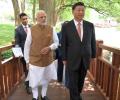
'India's preference today seems to be to exploit the deepening chill in relations with China to breathe new life into its meandering partnership with the US,' argues Ambassador M K Bhadrakumar.
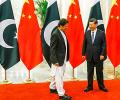
'If a 'two-front war' develops, Iron Brother may only turn out to be a drag on the PLA, since Pakistan is in no position to wage a war with India,' argues Ambassador M K Bhadrakumar.

Xi and Modi are scheduled to hold informal summit talks on Friday evening and on Saturday.
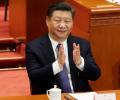
Xi ordered the military to think about worst-case scenarios, scale up training and battle preparedness, promptly and effectively deal with all sorts of complex situations and resolutely safeguard national sovereignty, security and development interests, state-run Xinhua news agency reported, without mentioning any specific issues that posed a threat to the country.

'The Indian version is that the two top diplomats merely exchanged pleasantries, while the Pakistani side characterised the encounter as an 'informal dialogue'.' 'The truth, as always in such piquant situations, is somewhere in between.' 'It stands to reason that ice has been broken,' says Ambassador M K Bhadrakumar.

This is a high-stakes strategic conflict between a power which wants to preserve the status quo in its favour and one which wants to usurp that throne. The rest is all theatre, says Harsh V Pant.

'The US appears to think that Pakistan is highly vulnerable today due to its economic crisis and one more turn of the screw may bring about desired results,' says Ambassador M K Bhadrakumar.

'If an 'informal meeting' with Xi Jinping materialises before the SCO summit in June, that itself could be regarded as a significant breakthrough in India-China relations,' says Ambassador M K Bhadrakumar.

'Xi's emphasis on enhancing conventional military deterrence capabilities, joint operations and power projection are likely to increase friction points with India as with other nations,' points out China expert Srikanth Kondapalli.
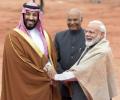
'No matter what Modi may boast about 'new India', the geopolitical reality is that India's stature diminishes when it needs a small country like Saudi Arabia under an autocratic ruler to help out with what is arguably one of the most critical templates of its diplomacy,' says Ambassador M K Bhadrakumar.

'While visits and personal meetings are useful, changes of strategic significance have occurred recently, with Beijing trying to take the lead which Modi must take note of.'
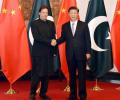
'The scheduling of Imran Khan's visit to Beijing and its focus on the J&K situation underscores that Beijing shares the Pakistani concern that tensions with India are only going to escalate further in the period ahead,' says Ambassador M K Bhadrakumar.

In remarks titled 'Implement Consensus and Handle Differences Properly to Bring China-India Relations Back on the Right Track' posted on the Chinese embassy website, Sun spoke of disruptions in the bilateral relationship and outlined five steps to clarify 'some fundamental points'.

'We should expect a cold-blooded, transactional relation that requires a lot of engagement and mutual trust to sustain,' says Constantino Xavier, Fellow, foreign policy, Brookings India.

'This novel format of diplomacy -- the informal summit -- will not only facilitate bilateral communication and reduce miscalculations at the very top level of the two governments, but possibly open the space for China and India to speak in one voice on various issues of mutual concern,' note Feng Renjie and Ding Kun Lei
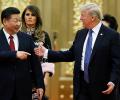
'What matters is that India's perspective on global issues -- climate change, intellectual property, free trade, trade routes being kept free, digital technology -- are listened to with respect,' says Ambassador B S Prakash.
 © 2026 Rediff.com - Advertise with us - Disclaimer - Privacy Policy - Sitemap - Feedback - About us - Terms of use - Grievances